Where it breaks.
The 24 documented AI failure modes on one printable page. Each one comes with its tell, in italics, and the control that catches it. Both are quoted from Part II of the AI “Keep Your Career” Bible.
It's built for a corkboard, a syllabus, or a career-center handout. It's set in a typeface designed for low-resolution output and has no heavy ink fills, so it survives a cheap photocopier.
No email required. Licensed CC BY-NC-ND 4.0: copy, print, post and share it for teaching, including in a learning management system, unchanged and with its notice. Not for resale.
Field Card 02 is next. Want it when it ships? One email per card, nothing else.
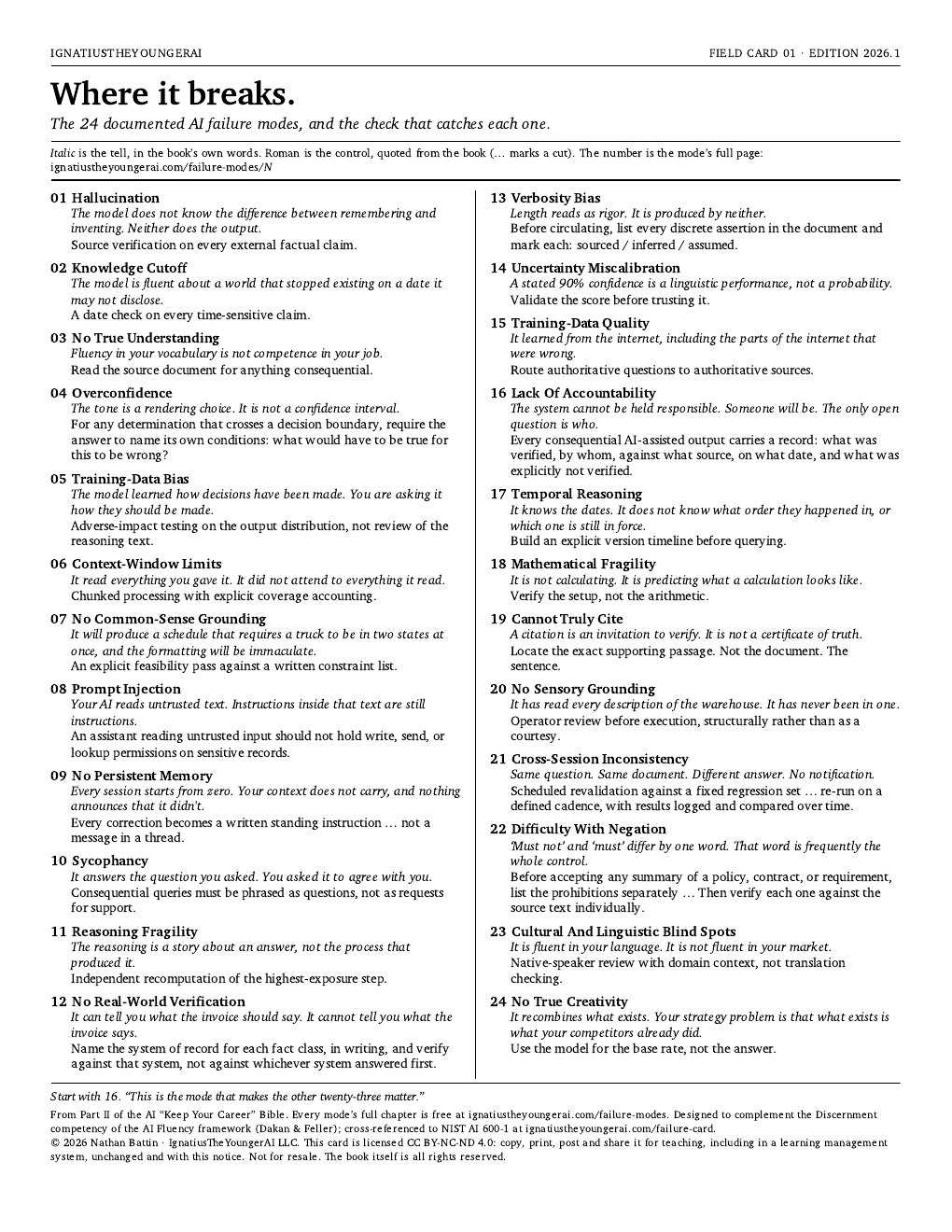
The 24 modes
The number is the mode's full page. The card uses the book's own numbering, so a citation of “mode 10” means the same thing everywhere on this site.
- 01 Hallucination
The model does not know the difference between remembering and inventing. Neither does the output.
Source verification on every external factual claim.
- 02 Knowledge Cutoff
The model is fluent about a world that stopped existing on a date it may not disclose.
A date check on every time-sensitive claim.
- 03 No True Understanding
Fluency in your vocabulary is not competence in your job.
Read the source document for anything consequential.
- 04 Overconfidence
The tone is a rendering choice. It is not a confidence interval.
For any determination that crosses a decision boundary, require the answer to name its own conditions: what would have to be true for this to be wrong?
- 05 Training-Data Bias
The model learned how decisions have been made. You are asking it how they should be made.
Adverse-impact testing on the output distribution, not review of the reasoning text.
- 06 Context-Window Limits
It read everything you gave it. It did not attend to everything it read.
Chunked processing with explicit coverage accounting.
- 07 No Common-Sense Grounding
It will produce a schedule that requires a truck to be in two states at once, and the formatting will be immaculate.
An explicit feasibility pass against a written constraint list.
- 08 Prompt Injection
Your AI reads untrusted text. Instructions inside that text are still instructions.
An assistant reading untrusted input should not hold write, send, or lookup permissions on sensitive records.
- 09 No Persistent Memory
Every session starts from zero. Your context does not carry, and nothing announces that it didn't.
Every correction becomes a written standing instruction … not a message in a thread.
- 10 Sycophancy
It answers the question you asked. You asked it to agree with you.
Consequential queries must be phrased as questions, not as requests for support.
- 11 Reasoning Fragility
The reasoning is a story about an answer, not the process that produced it.
Independent recomputation of the highest-exposure step.
- 12 No Real-World Verification
It can tell you what the invoice should say. It cannot tell you what the invoice says.
Name the system of record for each fact class, in writing, and verify against that system, not against whichever system answered first.
- 13 Verbosity Bias
Length reads as rigor. It is produced by neither.
Before circulating, list every discrete assertion in the document and mark each: sourced / inferred / assumed.
- 14 Uncertainty Miscalibration
A stated 90% confidence is a linguistic performance, not a probability.
Validate the score before trusting it.
- 15 Training-Data Quality
It learned from the internet, including the parts of the internet that were wrong.
Route authoritative questions to authoritative sources.
- 16 Lack Of Accountability
The system cannot be held responsible. Someone will be. The only open question is who.
Every consequential AI-assisted output carries a record: what was verified, by whom, against what source, on what date, and what was explicitly not verified.
- 17 Temporal Reasoning
It knows the dates. It does not know what order they happened in, or which one is still in force.
Build an explicit version timeline before querying.
- 18 Mathematical Fragility
It is not calculating. It is predicting what a calculation looks like.
Verify the setup, not the arithmetic.
- 19 Cannot Truly Cite
A citation is an invitation to verify. It is not a certificate of truth.
Locate the exact supporting passage. Not the document. The sentence.
- 20 No Sensory Grounding
It has read every description of the warehouse. It has never been in one.
Operator review before execution, structurally rather than as a courtesy.
- 21 Cross-Session Inconsistency
Same question. Same document. Different answer. No notification.
Scheduled revalidation against a fixed regression set … re-run on a defined cadence, with results logged and compared over time.
- 22 Difficulty With Negation
‘Must not’ and ‘must’ differ by one word. That word is frequently the whole control.
Before accepting any summary of a policy, contract, or requirement, list the prohibitions separately … Then verify each one against the source text individually.
- 23 Cultural And Linguistic Blind Spots
It is fluent in your language. It is not fluent in your market.
Native-speaker review with domain context, not translation checking.
- 24 No True Creativity
It recombines what exists. Your strategy problem is that what exists is what your competitors already did.
Use the model for the base rate, not the answer.
Start with 16. “This is the mode that makes the other twenty-three matter.”
Using it with a class
Hand it out before the first AI-assisted assignment. Ask students to find one mode in their own work that week and name the control they used. The card works without a position on whether students should use AI. Every mode holds either way.
Cross-references
AI Fluency framework. The card is designed to complement the Discernment competency of the AI Fluency framework by Rick Dakan and Joseph Feller, developed with Anthropic. That framework treats Discernment as a general competency. The card supplies the specific failures to discern. It is independent work: IY is not affiliated with the framework or its authors.
NIST AI 600-1. ANALYSIS The author's mapping of each mode to the closest risk category in NIST's Generative AI Profile. 7 fit a category directly, 11 most closely, and 6 have no NIST category at all. Those six are operational failures the federal harm taxonomy doesn't name.
| # | Mode | NIST AI 600-1 category | Fit |
|---|---|---|---|
| 01 | Hallucination | Confabulation | direct |
| 02 | Knowledge Cutoff | Confabulation | closest |
| 03 | No True Understanding | Human-AI Configuration | closest |
| 04 | Overconfidence | Confabulation | direct |
| 05 | Training-Data Bias | Harmful Bias and Homogenization | direct |
| 06 | Context-Window Limits | — | no NIST category |
| 07 | No Common-Sense Grounding | — | no NIST category |
| 08 | Prompt Injection | Information Security | direct |
| 09 | No Persistent Memory | — | no NIST category |
| 10 | Sycophancy | Human-AI Configuration | closest |
| 11 | Reasoning Fragility | Confabulation | closest |
| 12 | No Real-World Verification | Information Integrity | closest |
| 13 | Verbosity Bias | Human-AI Configuration | closest |
| 14 | Uncertainty Miscalibration | Confabulation | direct |
| 15 | Training-Data Quality | Information Integrity | closest |
| 16 | Lack Of Accountability | Value Chain and Component Integration | closest |
| 17 | Temporal Reasoning | Confabulation | closest |
| 18 | Mathematical Fragility | Confabulation | closest |
| 19 | Cannot Truly Cite | Confabulation | direct |
| 20 | No Sensory Grounding | — | no NIST category |
| 21 | Cross-Session Inconsistency | — | no NIST category |
| 22 | Difficulty With Negation | — | no NIST category |
| 23 | Cultural And Linguistic Blind Spots | Harmful Bias and Homogenization | direct |
| 24 | No True Creativity | Harmful Bias and Homogenization | closest |